Showing posts with label Articles. Show all posts

Friday, 20 June 2014

Yellow, Red and Green Foods: The Japanese Food Pyramid

Do you recognize this picture?

Western Food Pyramid

The Western Food Pyramid
Public Domain Image from Wikimedia

We've all been there on the school banks, look at that weird triangle with bread at the bottom and candy at the top – maybe you were like me, hoping that candy would find its way to the base of the pyramid. At least the one in my textbook still mentioned candy. The food pyramids I found on Wikimedia completely ignore this significant part of my diet.

The food pyramid is used all over the world – also in Japan. All they did here was replacing the types of food. Let's play spot the difference with this food pyramid picture.
Japanese Food Pyramid
Candy courtesy of Iris Hoppenbrouwers

  Guess what we got instead of bread? Yup, that's right, rice! All the categories show different kind of foods to better reflect the Japanese diet. Traditional Japanese food has a large emphasis on rice and fish. Even the vegetables are slightly different. Did you know that the Japanese radish is huge?

Daikon - Japanese Radish Vegetable
Seriously, it should be on the list of dangerous weapons.
There is one more difference. A single creative addition to our standard food pyramid... They added colours! Yay, now the pyramid has nice green, red and yellow colours. What do you think, does it look nice? 
 Japanese Food Pyramid in Colour
Wait, why did they do this? Was the standard pyramid boring? Oh, there is a purpose to pimping the pyramid.
In order to simplify healthy eating guidelines, the different food types were divided into three categories.
Red: stuff that makes you grow and keeps you strong
Green: stuff that keeps you healthy
Yellow: stuff that makes your body move
Makes sense?

The next part is a quick rehash of basic nutrition and biology. Skip it to read more about Japanese eating guidelines ^_^
Your body cells use glycogen as energy, which is derived from the food you eat.
Carbohydrates are the easiest source for your body to produce glycogen from. Protein and fat can be used to, but require longer for the body to process.
This is why food types with a lot of carbohydrates, like rice and bread, are put in the yellow category “makes your body move”.
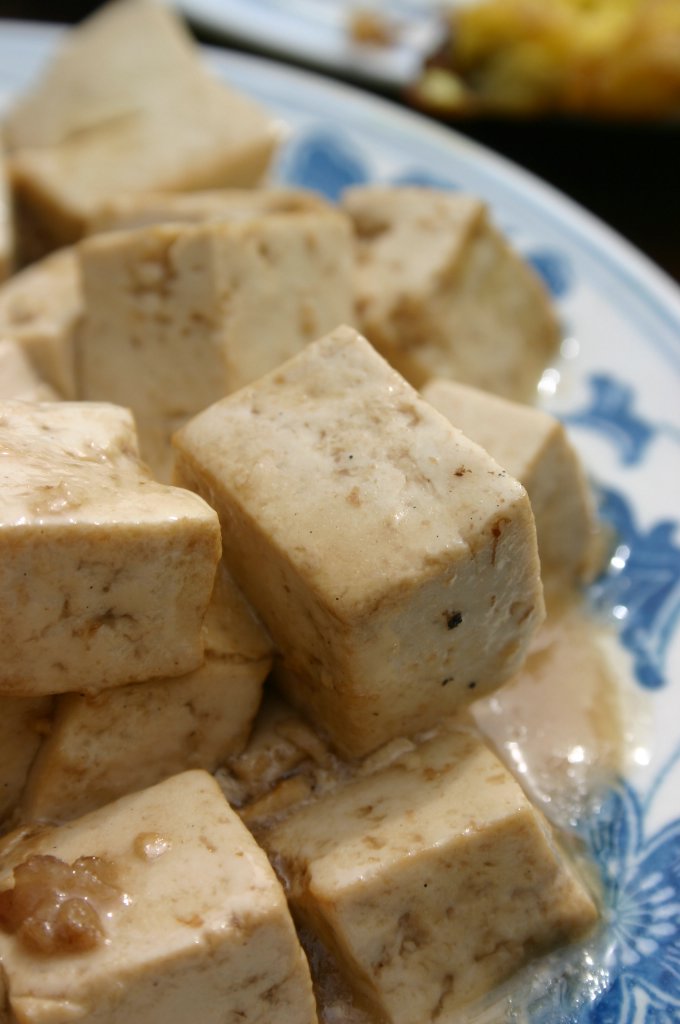
Tofu Dish Picture
Image from Wikimedia
For building muscle, making red blood cells and generally maintaining your body, you mainly need proteins. Iron and calcium are important too.
You find the perfect combination of these nutrients in animal product such as meat, fish and eggs. Vegans and vegetarians can combine specific plant sources to create a meal that provides the right nutrients. This takes some research and meal planning, but is doable. Tofu is an example of a plant product in the red category, so it gets much love from vegans.

For the green category, just think about vitamins and minerals, which you find lots of in vegetables and fruits.

So how does this apply to a healthy diet? The food guide in three colours let's you pick the right amount from each category.
For this, points were devised. 80 calories are one point and your goal is to acquire 16 points from yellow food, 6 points from red food and 3 points from green food. This will put you at a total of 2000 calories, with just the right balance of nutrients. If you don't cheat and count hamburgers as good food, that is...
As a guy you might want to shoot for 2500 calories, or 6-7 points extra. (note: some Japanese sources quote 2200-2600 for men and 1600-2000 for women. In the low bracket, women would consume 11 yellow food points.)
Using this easy to understand point system, it greatly simplifies creating your own healthy eating plan. So you can follow a healthy diet just counting colours!
Let's look at the system in practice.
In the cafeteria of Tottori University, the total calories and the food point of your meal are printed on your ticket.
Here's an example of mine:

Japanese Cafeteria Receipt - Calories and Points
Yellow points, red points, green points and a belly
filled with delicious school food.
The only option not included is the salad bar, since that dish varies a whole lot depending on whether you load up on pasta salad or broccoli.

However, outside the cafeteria the system falls apart.
Points are not written on packages. So when you eat something, you first have to determine what category the food belongs too. Yellow, red or green? It ain't mentioned anywhere. How do you know? Sure, there are a lot of examples in the food pyramid pictures, so you can kinda guess that all rice products will belong to the yellow category. But what about sushi? It has both rice and fish ingredients...
It doesn't end there. Next, you also need to calculate how many points your food is worth by dividing the total calories by 80.
So this chocolate chip cookie would be 3.8 points, if I would feel the need to pull out a calculator and do the math. I'd still be clueless about the colour category.

Let's get this straight: no one does this. It is impossible to spend so much mental energy on converting food package information to a food guide point system... for every single meal and snack... and then check the totals of the day...
Heck, we even have difficulties keeping track whether we get our five servings of veggies and fruit a day. This is insane!

Look, this system could provide for healthy eating habits. But the theory and the application are far apart. As a result, the whole method is ineffective.
I love the idea, but there is literally only one place where I can use it. If you want this system to work, the yellow, red and green points should be printed on all food packaging. If this was a standard on food packages, it would make a great tool for getting healthy eating habits.

In short: Great Idea, Poor Execution.
What do you think of this system? Would mentioning points on packages help to eat healthier?

Many thanks to professor Takeda of Tottori University, for answering all my questions about Japanese food education. 

Tuesday, 1 April 2014

APRIL 1ST: 7 Reasons Why You Shouldn't Worry About Global Climate Warming

Didn't it go awfully quiet on that big topic of climate change and drowning polar bears? The media doesn't seem to care anymore about global warming and melting polar ice. Well, neither should you.
I think Al Gore gave us all a big scare and then we were like “Meh, it's not that bad”. So I'm gonna tell you why there's no reason to worry about this carbon-dioxide stuff.


1. You'll die an ordinary death anyhow
When you're an old grandpa or grandma, guess how you'll leave this earth? Diabetes or heart attack, that's how. Nothing to do with global warming.
You ain't gonna get killed by huge hail rains in a tropical storm or by the sting of a monstrous malaria mosquito roaming the temperate climates. Where's the drama?

2. We'll run out of fossil fuels soon
Ain't us burning coal and oil the cause of this global warming thing? But we'll run out of those in a few decades, so then the problem will fix itself. Remember how the ozone layer fixed itself?

3. We got polar bears in zoos

polar bear melting ice danger
Bummer.

Polar caps melting means polar bears drowning, but that's actually not a big deal. We got them in zoos, so it's not like they will go extinct

I just saw pictures of the cutest twin polar bear cubs ever, born in some zoo somewhere. How many polar bears on the Arctic have their cuteness uploaded to the internet? They couldn't be less relevant to everyday life. 


4. If it was really that serious, somebody would do something about it
But instead, everyone kinda forgets that we got an issue here, so it's probably not that threatening. Or urgent.

5. We still got the government
If it looks like we're gonna drown, the government will simply build a sea dike with our taxpayers' money. If it looks like we're melting in extreme heat, or freezing because the polar vortex falls apart (or because we're not used to chilly weather anymore), then they can distribute cooling fans or heaters respectively!

6. You can always move
What if the government fails to do so? Still no problem. 
It's not like you're Bill Gates, but you are still well off enough to just move away when the climate starts to bother you. Village getting flooded every week? Move higher up. Crazy storms and tornadoes? The neighbouring country will do.
You are safe no matter what happens.

7. Global WARMING? Great, you never liked the cold!
Global warming sounds like more bikinis to me! Seriously, a summer short is way more comfortable than a ski jacket. And soon we can get our tan during Christmas break, at home! 
No more dying butterflies when winter comes around, it's gonna be an eternity of sunshine and rose petals! What's the downside again?


Thursday, 29 August 2013

The Internet Is For Awesome

The internet isn't awesome. You are making it awesome.

Why? Because you gather up all the nice and cool and fascinating stuff, and then you put it in your basket. You got a basket of internet awesome.

Look, here's something from my basket of awesome. It's okay, take it as a gift from me to you. 

Hyperbole and a Half
Allie from Hyperbole and a Half made the awesome and we share the awesome. We share it through the internet.
That makes the internet just as awesome as a telephone line. It just depends on whether you're sharing a mighty funny joke or the latest news on your grandmother's sister's kidney stone development. You shouldn't do the latter, just like I shouldn't summarize my complete post in the introduction.

I used to be a social media paria. I did have a Facebook and Twitter, but never used it. What was it for? Keeping in touch with people? Hell, I had plenty of options to contact my friends. I didn't see why we needed this.
Only this summer I figured out that social media aren't about friends. It's about finding the awesome.

Imagine being on the lookout for new music. You've gone through your playlists all to many times, you've gone to concerts of your big idols. How are you going to find something new?
You can google "cool music". You can look up the genre on Wikipedia and check what other bands match.
Or you can post on Facebook and have twenty not-really-friends-but-fun-people say "Hey, you like that band, aye? So try this!". 

I forgive you for rolling your eyes and saying "duh!". Hey, this was new to me. 

I discovered my hobby - digital painting - thanks to the internet. For twenty years, I had no idea digital painting existed. Until someone said "Check out this cool art!".
Same for webcomics. You like one webcomic, but finished reading it. Are you finding your new favourite through scanning a list of webcomics to date? More likely, you find the pot of gold through a recommendation, either directly, or through someone featuring it.

In short, I completely overturned how I used the internet. From making every trip to surfing the web a lonely quest, I first checked in the inn and asked what new thingies and stuffs people had discovered. In turn, I share what's worth sharing. Like this video:


Wednesday, 24 July 2013

How About Doing Something? Challenges: Daily, Weekly, Monthly, Yearly.


A lot of people have something to do. They know what they want to be - or already are. They have a job, a family or a passion to work for. They can do so day by day, letting it grow.

Yet, there are so many possibilities, that choosing is often impossible. How many of you have merely one interest? Sooner or later you'll have to choose, still not knowing what interest overpowers all the others. Not knowing whether the choice you've made is better than the choices you didn't make. Choosing a study, a job, a career.
Even picking a hobby can be challenging.

I found out how to pick a route and yet keep all roads open:
After hours challenges.

As long as you don't lock yourself inside the house, you'll end up in some not-so-great-yet-not-horrible job. That's your security. Usually, people pick a hobby to fill their spare time.
Others pick challenges.

Daily challenges, weekly challenges, monthly challenges, yearly challenges. 100 day challenges, one time challenges, three week challenges.


What kind of challenges? Anything, really.

Benjamin Franklin had a rotating cycle of thirteen virtues. Every week, he'd focus on battling one of those. He argued that by practicing them all, one at a time, someday they'd be ingrained in his nature.
He never managed a clean slate.
Yet, he said that practicing this helped him grow to personal success. That's an important clue. It's about doing the challenge, not about the results. Put up a little fight. If anything, it's a exercise of will power.

Then you have Matt Cutts, who also claims that taking on challenges improved his life wholly:
Matt Cutts who takes on a new challenge every month:


He mentioned NaNoWriMo, the challenge where you write a complete book in one month. That must be the prime example of how challenges bring out the best in people. How many people do you know that have a story in them, yet never finished writing it?
When I asked around, nearly everyone had started a book. A few were still writing new books every now and then. At least, the beginning of those books.
And then you've got those who brag about the amazing book they'll publish, but they haven't got one chapter yet.
Out of all the dozens of people I asked, only one had finished writing. (not me, sadly ;_;)
But on NaNoWriMo, people actually finish.
Out of all those people pretending to be writers, over 30,000 NaNoWriMo writers finish their book.

Some people take it even further, biting into one year challenges. Not just your average New Year resolution, but jumping onto something new and exiting.

My two favourites are "1000 Self Portraits" by Andrew Jones and "Dance in a Year" by Karen Cheng

Andrew Jones made a self portrait each day of the year. For three years. This is the result:

Full size image: http://www.thegnomonworkshop.com/news/wp-content/uploads/2013/04/andrew_jones_1000.jpg

The amount alone is impressive. His endless creativity is too: so much variation, so many different styles!

Then Karen Cheng, whose "I learned to dance in one year" video went viral:


Her idea was simple too: practice dancing every day. She's still going, after that year.
In September she launches a new website: Project 100, which will focus on practicing a skill for 100 days.

We sure like round numbers, don't we? Why not 52 days? 33 days. 126 days, maybe?

I found that hobbies don't work out for me. A few years ago, I bought a camera, but I'm still not taking pictures in my spare time. I have two sets of soft pastels, both unused. Never mind the forgotten stack of computer games.
I don't have full time career to focus on either. I gave up my childhood dream of becoming a caveman, so for now I'm just doing some university stuff.

Actually, I'm familiar with one particular challenge: lent. And that's it. (I always attempt  "no junk food for one day", but rarely persist past lunch.)

So yeah, looks like I need to take on these challenges, if I ever want to put my spare time to use.

Three questions to answer:
- what
- how
- when

The first two are easy, because I kinda selected beforehand. What: any hobby I attempted and didn't forget about yet. How: internet guidance.
When: ...
Eh. Will I pick a weekly, monthly or yearly challenge? I tried determining the ideal way to practice. A week is nice, because it's easy to carry through a mere seven days. But a year will yield the best results. Is a month the logical in-between? What about all the other options?

Maybe I better choose based on subjective preference. Well... I don't know which one I like best.
In that case, I ought to try them all and sift out my favourite.

Karen Cheng needs testers for her upcoming Project 100. That's my starting point.
(psst, you can apply too, till August)
A 100 day challenge. It isn't midnight yet. I can start today.
Then I'd finish the 100th day right when November starts, set to go for a monthly challenge. Maybe NaNoWriMo?
And when December comes around, I have all the time to set up a weekly challenge, before January marks the start of a one-year adventure.

It'll take me a while, but I can try them all and figure out whether it works or not. After all, I've already spend years on trying to acquire a hobby.
And then I'll be ready to figure out an adventure schedule.

Oooh, I know what I'm going to do for 100 days. I'm going to paint portraits. Horrible, hideous portraits at first. May they improve tenfold!

If you want to join, do so! Pick something - anything, really. You can start a thread on some forum, a blog, join a site like lift.do or just keep it private.
I haven't started yet, but I'm already promising you it'll be great.

Wednesday, 3 July 2013

My Favourite Japanese Person: Kotobuki Shiro

Who is your favourite Japanese person? 
Doesn't have to be a famous star, could also be your pen friend. Oh, and anime figures count too. I guess pop stars, movie stars and the like are among the most popular.
I was brooding about this, considering a variety of characters for the position. (Comparing Hard Gay and Mori Ōgai to each other was quite amusing :P)

They both lost.

My favourite Japanese person is... *drum rolls* Kotobuki Shiro. Okay! Pretend you didn't read the title and act surprised.
Actually, I should introduce him.
He's an artist. He draws cute girls. That's about it. Oh, and he's paralyzed so he draws with his mouth.

Here's an interview with him (Japanese spoken, but his awesomeness still shows):


HOW EFFING AMAZING IS THAT?
Holy Badger Pencil. Hey, check this. Here's my attempt at drawing a cute girl, compared to his:

Iris Hoppenbrouwers Kotobuki Shiro Cute Girl Painting
I wonder who the better artist is.

See? And I drew that with my four limbs working.
When I found out about him, I saw him as a huge inspiration. You know: "If he can do it, you can do it!"
That kinda stuff. I'd share the interview everytime someone complained about quitting art.

Yet, thinking about it, that didn't do him justice.
This isn't just "Woa, my able-bodied drawn pictures are worse than his, so I should feel encouraged."
It isn't just that his craft is amazing, giving his circumstances. Kotobuki himself is amazing. This doesn't show "anyone can do it with enough dedication". This shows how much dedication Kotobuki has. And determination. Optimism. Will power. Ambition. Confidence. Patience. Perseverance.

Mr. Kotobuki Shiro, I'm starting a mental list "Idols of Mine" and you're the first on it.

As a closing note, more inspiring quadriplegic artists:
Marcus Thomas: uses traditional oil paint to make beautiful nature paintings. He started painting after the ski accident that paralyzed him, in search of a way to fight boredom.
Michael Monaco: painting was recommended to him as a way to rehabilitate, now he's a professional painter. 
Edward Rainey: also started to paint after an accident paralyzed him. He felt the need to do something productive.
There's also a small collection of artworks by quadriplegic artists on Pinterest.

Now tell me who your favorite Japanese person is, and why!

Wednesday, 19 June 2013

Why Study When We Have Google?

Google My Brain
We can look up everything - so why learn anything?
You can read any book in any language. All the words can be found online. There are dozens – no hundreds and thousands, of translation machines and dictionaries. The grammar rules can be looked up and applied.
You shouldn't encounter any problems reading any book in any language - everything you need is online.

Now, we realize that isn't true. Yet, it's the same case for other domains of knowledge. But then we say "Why should I learn this? I can Google it!"
Knowledge is of practical use. That's why.
Take looking up a definition. Having a solid base gives you two important abilities:
1) You know where to look
2) You can understand the explanation

Why Google Is Insufficient
Let me give you two examples from when I was studying botany. I had to know what cellulose was precisely. So I went to Wikipedia.
"Cellulose is an organic compound with the formula (C6H10O5)n, a polysaccharide consisting of a linear chain of several hundred to over ten thousand β(1→4) linked D-glucose units."
Confused Look Cartoon Difficult 
Woa. That didn't help me. Even worse, it confused me and killed half of my frontal cortex cells, causing lifelong short attention spans when confronted with cellular components.

So I decided to ignore cellulose and read on in my syllabus. But then I encountered this:
"Hemicellusoses are heteropolymeres: after hydrolyses they appear to be composed of hexoses (glucose, galactose, mannose), pentoses (xylose, arabinose) and uron acids (glucuron acid and galacturon acid)."
Woaaaaaa. Wait a minute. I kinda understand some of the words. 
Hemithingies are heterothingies and heterothingies are composed of things like hexoses? So if I look up the hexose thingies, I'd understand what the rest means, right? ...right?

So I googled "hexose". Again, Wikipedia:
"In organic chemistry, a hexose is a monosaccharide with six carbon atoms, having the chemical formula C6H12O6. Hexoses are classified by functional group, with aldohexoses having an aldehyde at position 1, and ketohexoses having a ketone at position 2."
No. No, no, no. That isn't helping me at all.
What did I have to do? I could look up every word in every definition I encountered till it all made sense somehow... Heck, I have a final coming up right here, I don't have time, goddammit!
The problem was: I lacked knowledge. I did not have enough of a background in biochemistry to start on this part of botany. Which meant I was fucked, since I had that final lurking around the corner.

If I had enough knowledge, I would at least understand the explanation of things I had to look up. Secondly, there'd be a whole lot less I'd have to look up in the first place!

Music Clef Black WhiteCellulose versus Music
This example might not ring home for everyone. So hey, ever wanted to look up a song you didn't know the title of?
There are a few ways to go about this: do you know the album title? Then you can just check the track list. You could also look up the artist's name. If it's one of his popular songs the answer pops up directly. If not, you can sift through his discography.
If you know a few lines from the lyrics, it gets easy. Put those in a search engine and the song lyrics page will turn up, complete with artist and title.

Those are all bits of knowledge.

You memorized the album title, the artist's name, part of the lyrics... and use that to get to the desired piece of information.
If you don't know any of the above, what are you going to do? You could hum the melody for a friend and hope they recognize it.
Them recognizing it, means they have the required knowledge...

Knowledge and Internet
I believe that the internet makes it easier to 1) puzzle pieces of knowledge together 2) look up the missing pieces.
But once you memorize bits and parts of it, your limits expand. Basically, the more you know, the more you can look up.

You can always put knowledge to use - from writing a paper to telling funny anecdotes on a party (hey, did you know there's a disease that disables your automatic breathing?).
The more you know, the better.
So when you are reading/watching fun stuff online, why not remember some of it? I'm sure falling cats can teach you something about physics.

In short, the internet is a great, amazing, fabulous resource. And the greater you are, the greater the internet is for you. Makes sense?