Do you recognize
this picture?
 |
The Western Food
Pyramid
Public Domain
Image from Wikimedia
|
We've all been
there on the school banks, look at that weird triangle with bread at
the bottom and candy at the top – maybe you were like me, hoping
that candy would find its way to the base of the pyramid. At least
the one in my textbook still mentioned candy. The food pyramids I
found on Wikimedia completely ignore this significant part of my
diet.
The food pyramid
is used all over the world – also in Japan. All they did here was
replacing the types of food. Let's play spot the difference with this
food pyramid picture.
 |
Candy
courtesy of Iris Hoppenbrouwers
|
Guess what we got instead of bread? Yup, that's
right, rice! All the categories show different
kind of foods to better reflect the Japanese diet. Traditional
Japanese food has a large emphasis on rice and fish. Even the
vegetables are slightly different. Did you know that the Japanese
radish is huge?
 |
| Seriously, it should be on the list of dangerous weapons. |
There is one more difference. A single creative addition to our
standard food pyramid... They added colours! Yay, now the pyramid has
nice green, red and yellow colours. What do you think, does it look
nice?

Wait, why did they do this? Was the standard pyramid boring? Oh, there is a purpose to pimping the pyramid.
In order to simplify healthy eating guidelines, the different food types were divided into three categories.
In order to simplify healthy eating guidelines, the different food types were divided into three categories.
Red: stuff that makes you grow and keeps you strong
Green: stuff that keeps you healthy
Yellow:
stuff that makes your body move
Makes sense?
The next part is a quick rehash of basic nutrition and biology. Skip
it to read more about Japanese eating guidelines ^_^
Your body cells use glycogen as energy, which is derived from the food you eat.
Carbohydrates are the easiest source for your body to produce
glycogen from. Protein and fat can be used to, but require longer for
the body to process.
This is why food types with a lot of carbohydrates, like rice and
bread, are
put in the yellow category “makes your body move”.
 |
| Image from Wikimedia |
You find the perfect combination of these nutrients in animal product
such as meat, fish and eggs. Vegans and vegetarians can combine
specific plant sources to create a meal that provides the right
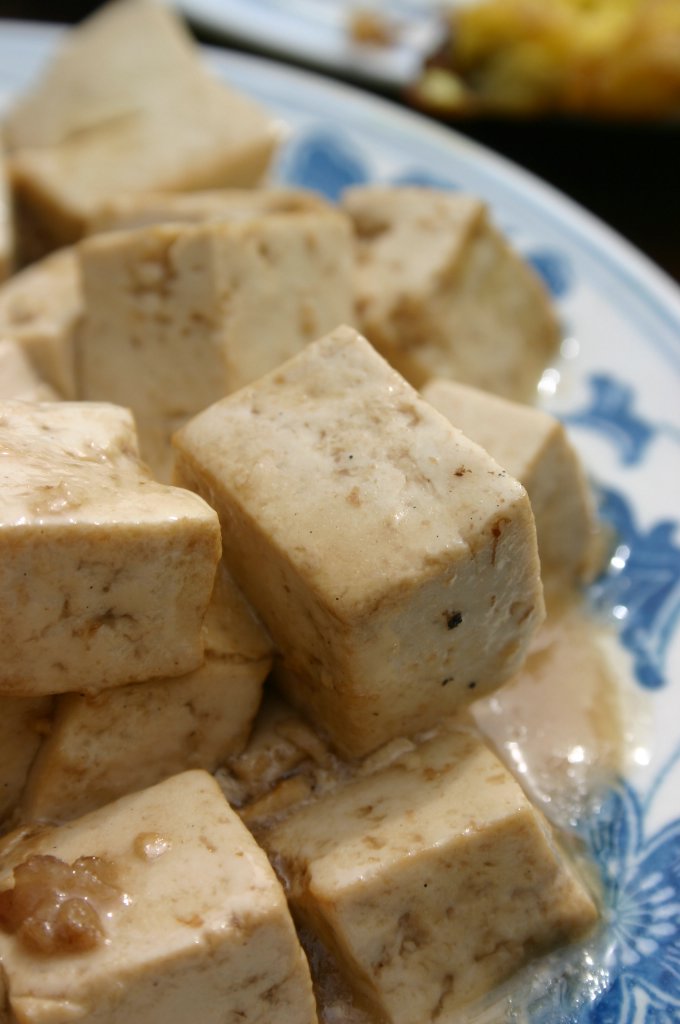
nutrients. This takes some research and meal planning, but is doable. Tofu is an example of a plant product in the red category, so it gets much love from vegans.
For the green category, just think about vitamins and minerals, which
you find lots of in vegetables and fruits.
So how does this apply to a healthy diet? The food guide in three
colours let's you pick the right amount from each category.
For this, points were devised. 80 calories are one point and your
goal is to acquire 16 points from yellow food, 6 points from red food
and 3 points from green food. This will put you at a total of 2000
calories, with just the right balance of nutrients. If you don't
cheat and count hamburgers as good food, that is...
As a guy you might want to shoot for 2500 calories, or 6-7 points
extra. (note: some Japanese sources quote 2200-2600 for men and
1600-2000 for women. In the low bracket, women would consume 11
yellow food points.)
Using this easy to understand point system, it greatly simplifies creating your own healthy eating plan. So you can follow a healthy diet just counting colours!
Using this easy to understand point system, it greatly simplifies creating your own healthy eating plan. So you can follow a healthy diet just counting colours!
Let's look at the system in practice.
In the cafeteria of Tottori University, the total calories and the
food point of your meal are printed on your ticket.
Here's an example of mine:
 |
| Yellow points, red points, green points and a belly filled with delicious school food. |
The only option not included is the salad bar, since that dish varies a
whole lot depending on whether you load up on pasta salad or
broccoli.
However, outside the cafeteria the system falls apart.
Points are not written on packages. So when you eat something, you first have to determine what category the food belongs too. Yellow, red or green? It ain't mentioned anywhere. How do you know? Sure, there are a lot of examples in the food pyramid pictures, so you can kinda guess that all rice products will belong to the yellow category. But what about sushi? It has both rice and fish ingredients...
Points are not written on packages. So when you eat something, you first have to determine what category the food belongs too. Yellow, red or green? It ain't mentioned anywhere. How do you know? Sure, there are a lot of examples in the food pyramid pictures, so you can kinda guess that all rice products will belong to the yellow category. But what about sushi? It has both rice and fish ingredients...
It doesn't end there. Next, you also need to calculate how many
points your food is worth by dividing the total calories by 80.
So this chocolate chip cookie would be 3.8 points, if I would feel
the need to pull out a calculator and do the math. I'd still be
clueless about the colour category.
Let's get this straight: no one does this. It is impossible to spend
so much mental energy on converting food package information to a
food guide point system... for every single meal and snack... and
then check the totals of the day...
Heck,
we even have difficulties keeping track whether we get our five
servings of veggies and fruit a day. This is insane!
Look, this system could provide for healthy eating habits. But the
theory and the application are far apart. As a result, the whole
method is ineffective.
I love the idea, but there is literally only one place where I can
use it. If you want this system to work, the yellow, red and green
points should be printed on all food packaging. If this was a
standard on food packages, it would make a great tool for getting
healthy eating habits.
In short: Great Idea, Poor Execution.
What do you think of this system? Would mentioning points on packages help to eat healthier?
Many thanks to
professor Takeda of Tottori University, for answering all my
questions about Japanese food education.


